



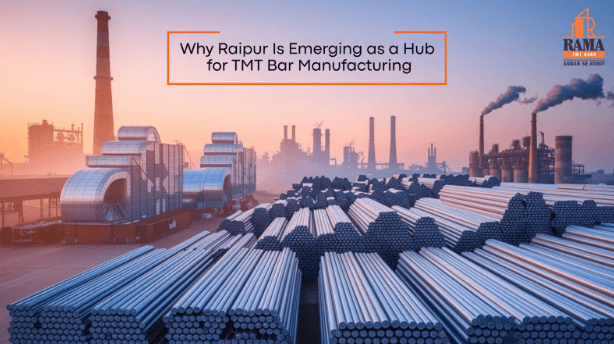
In recent years, Raipur, the capital city of Chhattisgarh, has become a prominent name in the steel industry, particularly for the manufacture of TMT (Thermo-Mechanically Treated) bars. But why is Raipur fast becoming a hub for TMT bar manufacturing? Several interlinked factors — from resource availability to policy support — are driving this trend. In this blog, we explore the key reasons behind Raipur’s rise and what it means for the future of India’s construction and infrastructure sectors.
Rich Mineral Resources and Strategic Location
One of the most fundamental reasons for Raipur’s emergence as a TMT bar manufacturing hub is its proximity to abundant mineral resources. Chhattisgarh is known for its large deposits of iron ore, coal, and limestone — essential raw materials for steel production. These resources help steel units to reduce transportation costs and ensure a steady, local supply of raw material.
Moreover, Raipur enjoys a strategic location. It is well-connected via rail and road to major industrial and consumption centres, and logistics costs remain comparatively low. Being centrally located in India, Raipur serves as a natural node to cater to demand from nearby states and infrastructure projects.
Well-Developed Steel Ecosystem
Raipur’s industrial ecosystem is mature and well-integrated. It hosts a significant cluster of rolling mills, re‑rolling units, and induction furnace‑based SMEs, contributing to a robust steel manufacturing base. According to reports, the Raipur district has around 135 micro, small, and medium-scale steel re-rolling units. This means that not only large integrated steel plants, but also smaller units, contribute to a thriving TMT bar ecosystem.
One major advantage of such a cluster is economies of scale — inputs like billets or sponge iron can be shared or sourced collectively, reducing costs for individual units. It also encourages specialisation, where different companies focus on upstream (sponge iron), midstream (billets), and downstream (TMT bars) operations.
Presence of Leading Steel Manufacturers
Several reputed steel companies operate in or around Raipur, underscoring the region’s importance in steel manufacturing:
- Real Ispat & Power Ltd, based in Raipur, is one of the leading integrated players. It produces sponge iron, billets, wire rods, and TMT rebars under the brand name GK TMT.
- Raipur Power and Steel Ltd (RPSL) has a fully integrated facility, with sponge iron kilns, induction furnaces, and a rolling mill that produces TMT bars.
- Blue Lines TMT (by SKA Steel and Power) has a rolling unit in Raipur’s Urla Industrial Area and manufactures TMT bars using modern technology.
Efficient Power & Energy Infrastructure
Steel manufacturing, especially at this scale, requires a stable and reliable power supply. Raipur has made considerable strides in building the necessary energy infrastructure. For instance, many plants in the region, including those of the TMT steel manufacturer, run captive power plants with waste-heat-recovery boilers (WHRB), which make the operations more energy efficient.
This self-sufficiency in power helps manufacturers reduce reliance on external energy sources, thereby lowering production costs and improving margins.
Supportive Industrial Policy & Governance
Chhattisgarh’s government has been proactively encouraging industrial growth, and Raipur is at the centre of this push. Policy measures and economic incentives have made it easier for businesses to set up and operate steel manufacturing units here. According to some business setup guides, Chhattisgarh offers favourable policies for mineral-based industries, including incentives for MSMEs.
More recently, the One-Click Single Window System 2.0, launched by the state government, has streamlined industrial approvals, reduced bureaucratic hurdles, and made it simpler for new investors to set up units in Raipur. This kind of business-friendly governance is vital for capital-intensive industries like steel.
Environmental Considerations & Sustainable Practices
Modern steel plants in Raipur are increasingly adopting eco-friendly and energy-efficient technologies. The proposed project mentioned in environmental clearances (TOR) shows plans for captive power plants and waste heat recovery. By capturing and reusing waste heat, these plants reduce carbon emissions and make production more sustainable and cost-effective.
This aligns with global trends where steel manufacturers are under pressure to reduce their carbon footprints. The use of cleaner technology not only supports sustainability but also ensures long-term economic viability for TMT bar producers in Raipur.
Strong Demand from Construction & Infrastructure
India’s construction and infrastructure sectors are booming, and TMT bars are a critical component in almost every concrete structure — from residential buildings to bridges, highways, and commercial complexes. With increasing demand for the Best TMT bars for construction in India, Raipur benefits from both strong local demand (as Chhattisgarh urbanises) and national infrastructure projects that require a reliable steel supply.
Moreover, Raipur’s export potential is rising. Industrial exporters based in Raipur, like Rathore Exim, highlight iTMT bars in their product range for international markets. This dual demand – domestic and international – makes Raipur’s TMT bar manufacturing especially attractive.
Skilled Workforce & Industrial Talent
With a growing industrial ecosystem spanning small to large units, Raipur has access to a skilled and semi-skilled workforce familiar with steel and metallurgical operations. Workers trained in rolling mills, induction furnaces, casting, and quality control make up a valuable labour pool.
This talent base, combined with relatively lower labour costs compared to more established industrial hubs, gives Raipur an edge as a manufacturing destination.
Cluster Benefits & MSME Participation
The presence of many MSME steel re-rolling units around Raipur fosters healthy competition and collaboration. These smaller units can quickly adapt, innovate, and scale up. According to a report, the Raipur cluster produces around 3.3 million tonnes per annum (MTPA) from re-rolling units.
MSMEs contribute significantly to local employment, generate ancillary demand (for transport, power, raw materials), and also strengthen the value chain by supplying recycled or intermediate materials. Their presence ensures that Raipur’s TMT bar ecosystem is not just concentrated in big firms but distributed, resilient, and diverse.
Connectivity & Logistics Infrastructure
Improved logistics infrastructure is another big factor. Raipur’s connectivity — by road, rail, and industrial corridors — makes it easier to transport raw materials in and finished TMT products out. Emerging corridors like expressways and industrial parks further boost its attractiveness for steel manufacturers.
With this efficient transport infrastructure, manufacturers can keep their supply chain tight, reduce lead times, and deliver more competitively to both domestic markets and export clients.
Challenges & Considerations
While Raipur’s rise as a TMT bar hub looks promising, it faces some challenges:
1. Environmental Pressures:
Steel manufacturing has a large environmental footprint. Maintaining compliance with environmental norms and managing emissions will be critical.
2. Infrastructure Bottlenecks:
As demand grows, infrastructure (roads, water, power) may need continuous upgradation to support expanding capacity.
3. Competition:
Other steel hubs in India (like those in Jharkhand, Odisha, and Maharashtra) continue to compete aggressively. Raipur will need to maintain cost advantages and technological competitiveness.
4. Skilled Labour Shortage:
While there is a workforce, scaling up production may require more specialised engineers and technicians familiar with advanced steel manufacturing.
Frequently Asked Questions (FAQs)
1. Why is Raipur emerging as a hub for TMT bar manufacturing?
Raipur benefits from abundant raw materials, a skilled workforce, strategic location, robust industrial ecosystem, and government support, making it ideal for TMT bar production.
2. Are Raipur TMT bars suitable for large infrastructure projects?
Yes, TMT bars from Raipur meet BIS quality standards and are widely used in residential, commercial, and large-scale infrastructure projects across India.
3. What role does raw material availability play in Raipur’s TMT industry?
Chhattisgarh’s rich deposits of iron ore, coal, and limestone reduce production costs and ensure a steady supply, strengthening Raipur’s TMT bar manufacturing capabilities.
4. How can I source TMT bars from Raipur for my construction project?
You can directly contact local manufacturers, authorised distributors, or online suppliers in Raipur to procure high-quality TMT bars for construction needs.
5. Can TMT bars from Raipur be exported?
Yes, several manufacturers in Raipur supply TMT bars not only to domestic markets but also to international buyers, making it a growing export hub.
Raipur’s emergence as a hub for TMT bar manufacturing is no accident. Rich mineral resources, efficient power infrastructure, a mature steel ecosystem, supportive policies, and a growing demand base all contribute to this transformation. Leading companies like Real Ispat, Raipur Power & Steel, and Blue Lines TMT are turning Raipur into a significant centre for high-quality TMT production.
The city’s ability to combine scale with sustainability, local advantage with global vision, and entrepreneurial spirit with institutional backing makes it a compelling case study for industrial growth. For investors, steel makers, TMT bar manufacturer in Raipur, and construction businesses alike, Raipur offers a robust platform to tap into India’s infrastructure boom.
As India continues to build more homes, highways, and high-rise structures, Raipur is likely to play an even more central role in reinforcing India’s future — quite literally — one TMT bar at a time.